Clarinet intonation
Every clarinet has a tuning map. Here is mine.
You tune to the A, the tuner says zero, and you are done. But the A is one note out of forty-odd. Some of the others sit above the line, some below, and they do it every time you play them. Experienced clarinetists know these spots on their own instrument and correct them without thinking. Most of us only find out when the section leader looks over.
My clarinet, note by note
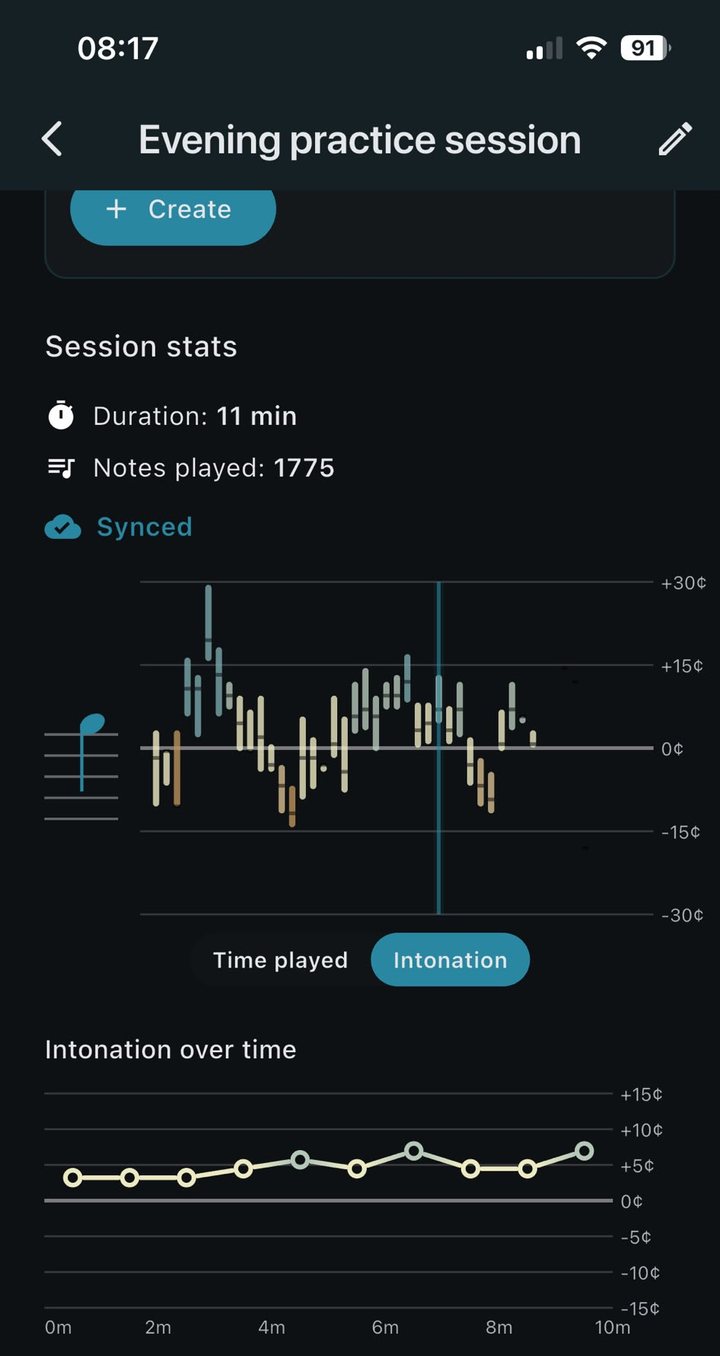
On 30 September I played four 10-minute sessions in a row on my Buffet Crampon Festival. This is the third one: the clarinet was warm by then, and its overall pitch moved by only about 4 cents over the ten minutes. Clariva measured every note against A = 442 Hz, the pitch I tune to: 1,775 notes. Below is the average of each note, written the way you read it in a B♭ clarinet part.
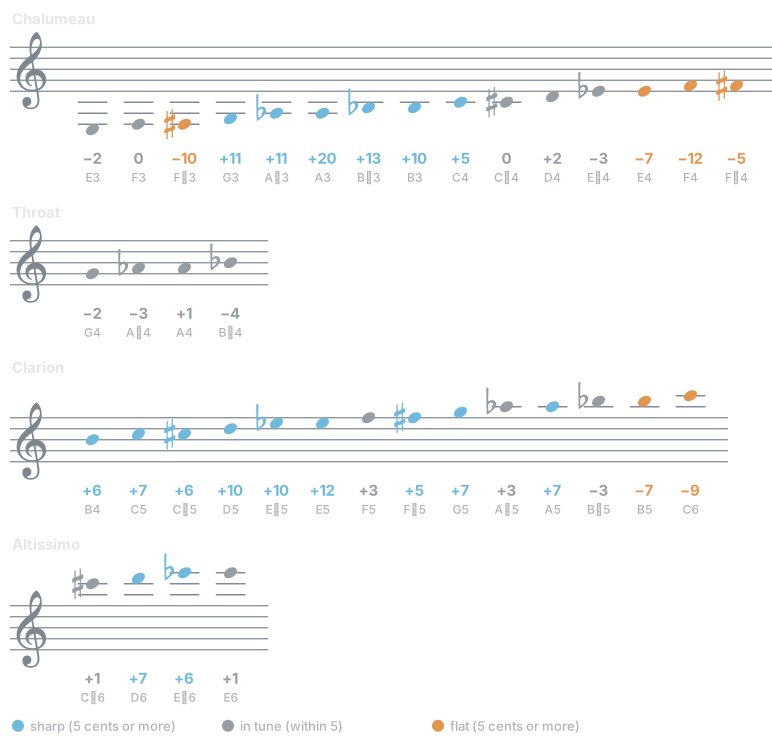
What stands out:
- the low G, A♭, A and B♭ below the staff are the sharpest, 11 to 20 cents,
- the E and F at the bottom of the staff are flat, 7 and 12 cents,
- the clarion from B to A sits mostly 5 to 12 cents high, while the throat notes are in tune and the top of the clarion (B♭ to C) drops to 9 cents flat.
What teachers say, and whether my clarinet agrees
Clarinet teachers have written down the usual suspects for a long time. The clarinetist David Bourque lists tendencies common to most instruments and players in "Better Tuning"; Gregory Dufford describes others in The Instrumentalist. Here they are next to my measurements.
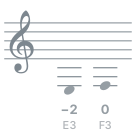 Low E and F can be quite flat, especially when played loud (Bourque).
Not on mine. In tune: −2 and 0.
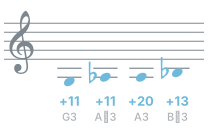 The low A tends to be sharp (Dufford).
Yes, and its neighbours too. A +20,
G, A♭ and B♭ +11 to +13.
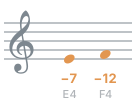 E can be flat (Dufford). From this E upwards the pitch bends more easily with
the embouchure (UNSW acoustics).
Yes, and F even more. −7 and
−12.
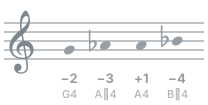 Throat tones go flat when loud and sharp when soft (Bourque).
On average in tune: −4 to
+1. Depends on the dynamics.
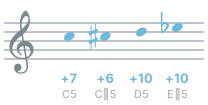 Clarion C, C♯ and D are sharp; E♭ is often bright and sharp
(Bourque).
Yes. +6 to +10.
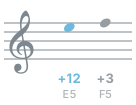 Clarion E and F can be sharp, E more than F, especially when tongued (Bourque,
Dufford).
Yes, E more than F. +12 and +3.
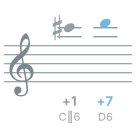 Altissimo C♯ and D are sharp (Dufford, Bourque), F♯ is flat
(Bourque).
Partly. D +7, C♯ in tune;
no F♯ in this session.
Five of seven match, at least in part. So the textbook knows a lot about my clarinet, but not everything: my low E and F, the classic flat notes, are fine, and the flat ones are the E and F an octave higher.
Why: one register key for many notes
The clarinet is a cylinder closed at the reed end. Such a tube does not jump an octave when you overblow, it jumps a twelfth: the same fingering with the register key gives a note an octave and a fifth higher. Ideally, every note would have its register hole at a slightly different place. There is only one register key, so its position is a compromise.
It is not the only effect. The acousticians Vincent Debut, Jean Kergomard and Franck Laloë showed that the open tone holes, the bore and the bell shift the twelfths the other way and partly cancel the register hole's error, and that makers already place the register hole close to the best possible spot. What remains: the lowest twelfths come out slightly too wide. Any clarinet built this way has that.
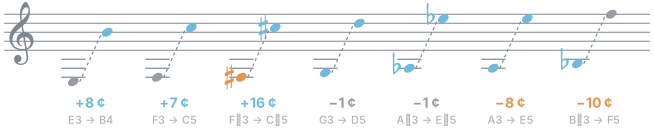
My clarinet shows exactly that: the three lowest twelfths are 7 to 16 cents wide, which is why my clarion sits higher than the low notes it is built on. Further up the twelfths are close or even narrow, and that is where the sharp low G, A and B♭ come from: they are sharp already, before the register key.
The throat notes have their own problem. As the music acoustics group at UNSW Sydney describes, from the E at the bottom of the staff upwards the instrument has fewer strong resonances, so the pitch follows the lips and the shape of the mouth more easily. That makes these notes easy to correct, and easy to get wrong.
Is it my Festival, or every clarinet?
Both. The physics above is the same for every clarinet. Where exactly the holes are, how big and how undercut they are, and the exact shape of the bore differ from model to model, and a little from one instrument to the next. That changes the details of the map.
I have not found per-note tuning charts published by Buffet Crampon. But the Festival's own history is telling. Buffet introduced it in 1987, and in 2024 brought out a new version whose intonation "has been reworked". In Buffet's launch video, the clarinetist Nicolas Baldeyrou, who has played the Festival for 30 years, explains what changed: on the old B♭ Festival the right-hand notes of the clarion ran a little high, particularly E♭, D, C♯ and C. Players corrected them with the mouth; the new B♭ model has its tone-hole layout ("pointage") shifted 1 mm downwards to rebalance them, and a bell 2 mm shorter. On the A clarinet, low E and F used to be low, and that has been fixed too. Mine is the older B♭ model, and in this session, warm and against 442, those notes are +6 to +10. That part of my map is the instrument, not me.
What makers do about it
- Extra keys. Buffet's Tosca has a "low F correction key": a 19th key that the 18-key Festival does not have, for the low F that Bourque lists as a classic flat note.
- Bore and body. Different bore designs give different maps, and small changes such as the new Festival's tone holes, shifted by 1 mm, move single groups of notes.
- Barrels. A longer or shorter barrel moves every note, the throat notes most, because their sounding tube is the shortest.
- The technician. Undercutting a tone hole raises a note; tape or epoxy at the hole lowers it. Both Bourque and Dufford describe it.
- The player. Voicing, embouchure and alternate fingerings, especially in the throat and the altissimo.
Clarinet or player?
Both, in different places. The wide low twelfths and the clarion C to E♭ on my clarinet are the instrument. The flat E and F at the bottom of the staff, where the pitch bends easily, are probably at least partly me. A fixed chart from a book cannot tell you which is which. Measuring your own playing, and measuring again after a new barrel, reed or habit, can.
How to find your own map
With a tuner. Bourque's approach: play slow scales against a drone or a tuner in listening mode, check each note as you land on it, then repeat at other dynamics. It works, with one catch: while you watch the needle, you correct. Lips, air and voicing pull every note towards the centre, often without you noticing, so the tuner mostly shows how well you can fix a note when you have time to look. In a real passage there is no time to look, and the notes come out where your instrument and your habits put them.
From your normal practice
Your own tuning map, after every session
This is why I built Clariva. You practise as usual with your phone on the stand. The app finds every note and measures it against your reference pitch: 440, 442, or whatever your orchestra uses. The session page then shows your map, the notes that stand out, and how your intonation moved while the instrument warmed up.
While you play you read your music, not a needle, so you don't adjust to one. The map builds up from your real playing, session after session: your instrument together with the corrections your embouchure already makes on its own. That is the picture that matters in a rehearsal, and it shows whether a new barrel, reed or habit really changed anything.


Free to download and use. iPhone: in Apple's review, the iOS beta works until then.
Free to download and use.
Sources
- David Bourque, "Better Tuning", Keys to Better Wind Playing (2012): davidbourque.ca (PDF)
- Gregory Dufford, "Overcoming Clarinet Tendencies", The Instrumentalist, February 2009: theinstrumentalist.com
- V. Debut, J. Kergomard, F. Laloë, "Analysis and optimisation of the tuning of the twelfths for a clarinet resonator": arxiv.org
- Music Acoustics, UNSW Sydney, "Acoustics of the clarinet", written E4: phys.unsw.edu.au
- Buffet Crampon, "Nicolas Baldeyrou present The New Festival Buffet Crampon Clarinet", video, 12 June 2024 (in French): youtube.com/@BuffetCramponParis
- Buffet Crampon, New Festival clarinet (launch site, 2024): bc-newfestival.com (archived)
- Buffet Crampon, Tosca clarinet, product page: buffetcrampon.com
Christoph Eggimann plays the clarinet and builds Clariva. Note names are written pitch for the B♭ clarinet. Values are the median of each note over one 10-minute session on 30 September 2026, against A = 442 Hz; the screenshot shows the same session.